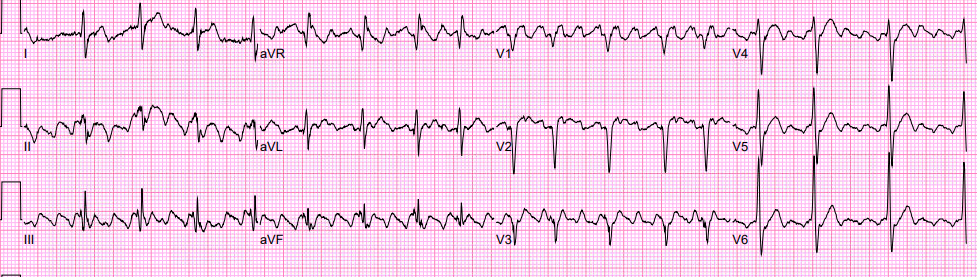
Indications
- Symptomatic typical (CTI-dependent) atrial flutter — first-line, often preferred over chronic antiarrhythmics
- Recurrent flutter despite rate or rhythm control
- Flutter induced by class IC or amiodarone therapy for AF — common in patients on rhythm control
- Tachycardia-mediated cardiomyopathy from persistent flutter
- Combined PVI + CTI in patients with both AF and documented typical flutter
Less straightforward:
- Atypical flutter — requires 3D mapping and is a different (longer, harder) procedure
- Asymptomatic flutter with good rate control and tolerated anticoagulation
Pre-procedure prep
- Anticoagulation for at least 3 weeks at therapeutic levels, or TEE within 24 hours if duration uncertain
- Anticoagulation rules for flutter mirror AF — do not skip this
- NPO after midnight, baseline ECG, electrolytes, INR if on warfarin
- Antiarrhythmics: typically continued through the procedure; useful for inducing the arrhythmia if not present
- Sedation plan: most CTI ablations are well tolerated under moderate sedation; general anesthesia rarely needed unless patient factors dictate
Setup & equipment
- Single right femoral vein access is often sufficient; dual access for cases requiring mapping catheter
- Decapolar catheter to the coronary sinus through the os, proximal poles in the RA
- Ablation catheter via a long sheath to improve stability across the isthmus
- Heparin to ACT 250–300 once catheters are in
- 3D mapping optional for routine typical flutter; mandatory for atypical
Technique
Confirming the diagnosis
- In flutter at the start: activation mapping shows counterclockwise (or clockwise) rotation around the tricuspid annulus
- In sinus rhythm: induce with burst pacing from the CS or RA, then confirm circuit with entrainment
- Entrainment from the isthmus: post-pacing interval equals tachycardia cycle length within 30 ms confirms CTI dependence
Ablation strategy
- Linear lesion from the tricuspid annulus to the IVC across the cavotricuspid isthmus
- Start at the ventricular edge — large A and small V signals — and drag toward the IVC
- 30–50 W irrigated RF, contact force 10–30 g
- Watch for impedance drop and signal attenuation along the line
- Anatomic challenges: pouches, ridges, and the Eustachian ridge can require catheter reshaping or switching to a steerable sheath
Confirming bidirectional block
This is the procedural endpoint and easy to falsify if you don’t test rigorously.
- Pace from CS proximal, observe activation sequence along the lateral RA — should travel up the septum, across the roof, down the lateral wall (counterclockwise around the annulus). No conduction across the isthmus.
- Pace from lateral RA, observe activation along the CS — should travel up and over the roof to reach CS proximal. No conduction across the isthmus.
- Differential pacing: pace from sites progressively closer to the line; the local electrogram should appear after the activation has traveled around the annulus
- Wait 20–30 minutes after the final lesion and reconfirm
If block isn’t durable, look for gaps along the line (often near the Eustachian ridge or ventricular insertion) and touch up.
Atypical flutter notes
- Build a high-density 3D activation map covering the full tachycardia cycle length
- Identify the circuit and the critical isthmus
- Target the narrowest, slowest segment of the circuit
- Common left atrial circuits: perimitral (requires line to mitral annulus), roof-dependent (line across the roof), septal
Complications
- Vascular access complications (~1%)
- AV block (<1%) — from catheter migration superiorly; constant fluoroscopic and electrogram monitoring
- Right coronary artery injury (rare) — the RCA runs in the AV groove near the isthmus
- Tamponade (rare with CTI ablation specifically)
- Recurrence — typical flutter recurrence after documented bidirectional block is 5–10%, usually from line reconnection
Post-procedure care
- Bed rest 2–3 hours with groin pressure, then ambulate
- Same-day discharge is standard for uncomplicated cases
- Anticoagulation continues for at least 4 weeks; long-term anticoagulation per CHA2DS2-VASc
- Counseling on AF risk: 25–35% of patients develop AF within 2 years even after successful flutter ablation. Set this expectation up front; monitor for it.
- Follow-up at 4–6 weeks with rhythm assessment